A typical PEB roof is held on by thousands of screws. Each one carries part of the wind uplift and passes through the weatherproof skin. If the fasteners corrode, loosen or leak, the best panels in the world will fail. This guide covers the small components that hold the envelope together.
Self-drilling screws
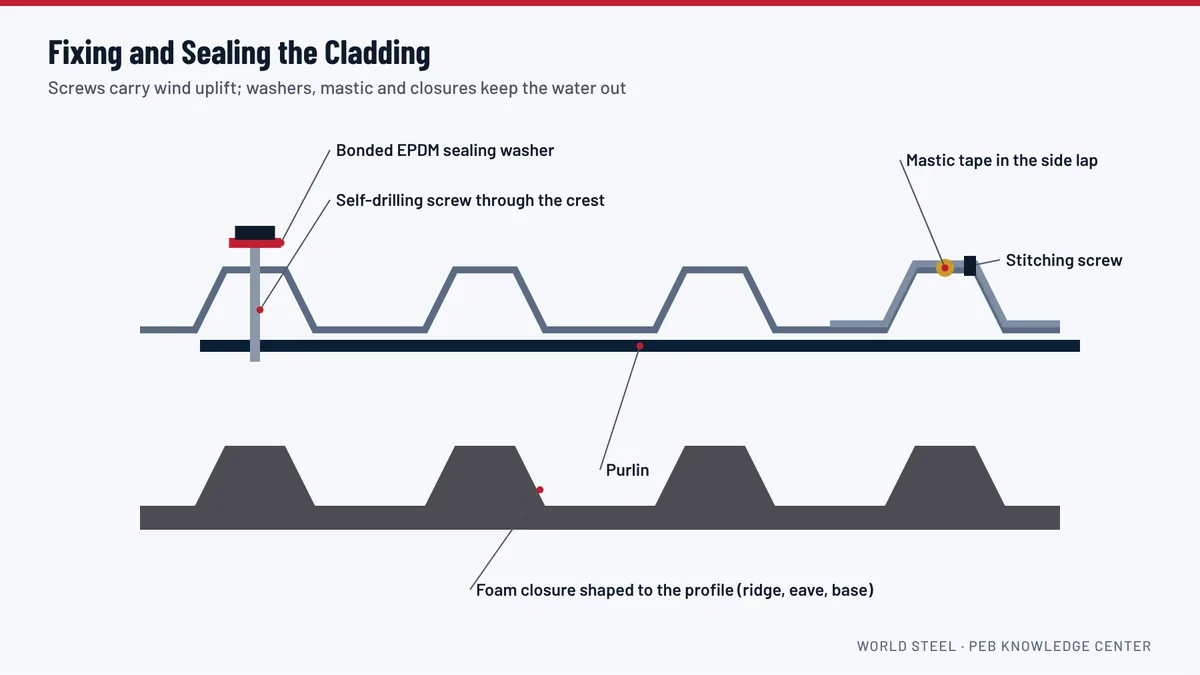
Roof and wall panels are fixed to purlins and girts with self-drilling screws, which drill their own hole and form a thread in one operation. Each screw has a bonded washer, a steel or aluminium washer with an EPDM rubber seal, that seals the hole when the screw is tightened. Key choices are:
- Drill point and thread suited to the thickness of the purlin or girt;
- Length to pass through the panel, any insulation and the support;
- Corrosion class: coatings rated by standards such as AS 3566 Class 3 or Class 4, or stainless steel for very aggressive sites;
- Head colour matched to the panel.
Installing screws correctly
Use a screw gun with a depth-setting nose. The washer should be compressed until the rubber just begins to spread beyond the steel washer; under-tightened screws leak, over-tightened screws crush the washer and dimple the panel. Screws must be perpendicular to the panel. Roof screws are usually placed through the crest of the rib (for weather-tightness) or the valley (for wall panels), as specified by the panel manufacturer.
Stitching screws and rivets
Short stitching screws join panels to each other at side laps and fix trims and flashings. Blind (pop) rivets are used where a smooth head or a thin-sheet connection is needed, for example on gutters and some trims. Both must be compatible with the panel coating.
Foam closures
Profiled foam closures match the shape of the panel ribs. They fill the gaps at ridges, eaves, bases and opening heads, keeping out wind-driven rain, insects, birds and dust. Closures are a small item that is often forgotten on site, with large consequences.
Mastics and sealants
- Butyl mastic tape is placed in side laps and end laps of low-slope roofs and under flashings to make a continuous seal.
- Flowable sealant fills small gaps at trims and penetrations.
- Pipe flashings seal round penetrations through the roof.
Sealants must remain flexible to accommodate thermal movement of the steel.
Swarf and dissimilar metals
Drilling produces small steel shavings (swarf) that land on the roof and rust within days, staining the coating. Sweep the roof clean at the end of every working day. Avoid contact between coated steel and copper or treated timber, which accelerates corrosion.
For projects in Guyana
In coastal Guyana, fasteners often corrode before panels do, so World Steel recommends fasteners with a corrosion class at least equal to the panel coating, and stainless steel in the most exposed locations. All screws, closures and mastics are supplied with the kit, counted to the sheeting layout with a spare allowance. Pending verification confirm the standard fastener corrosion class supplied for coastal Guyana projects
Frequently asked questions
Why do roof screws leak?
Usually because they were over- or under-tightened, installed at an angle, or the washer is degraded. Correct installation with a depth-setting tool prevents most leaks.
Should screws go through the crest or the valley of the roof sheet?
On roofs, usually through the crest so water flows away from the hole; follow the panel manufacturer's instructions for the profile.
What is swarf and why does it matter?
Swarf is steel filings from drilling. Left on the roof, it rusts and stains the panels. Sweep it off daily.