A bare steel roof in the tropics heats up quickly in the sun, radiates that heat into the building, and is very loud in heavy rain. At night it cools quickly, and moisture from the warm, humid air inside condenses on its underside and drips onto goods and equipment. Insulation addresses all three problems. For most occupied or storage buildings in hot, humid climates, it is one of the best-value upgrades in the whole building.
Why condensation happens
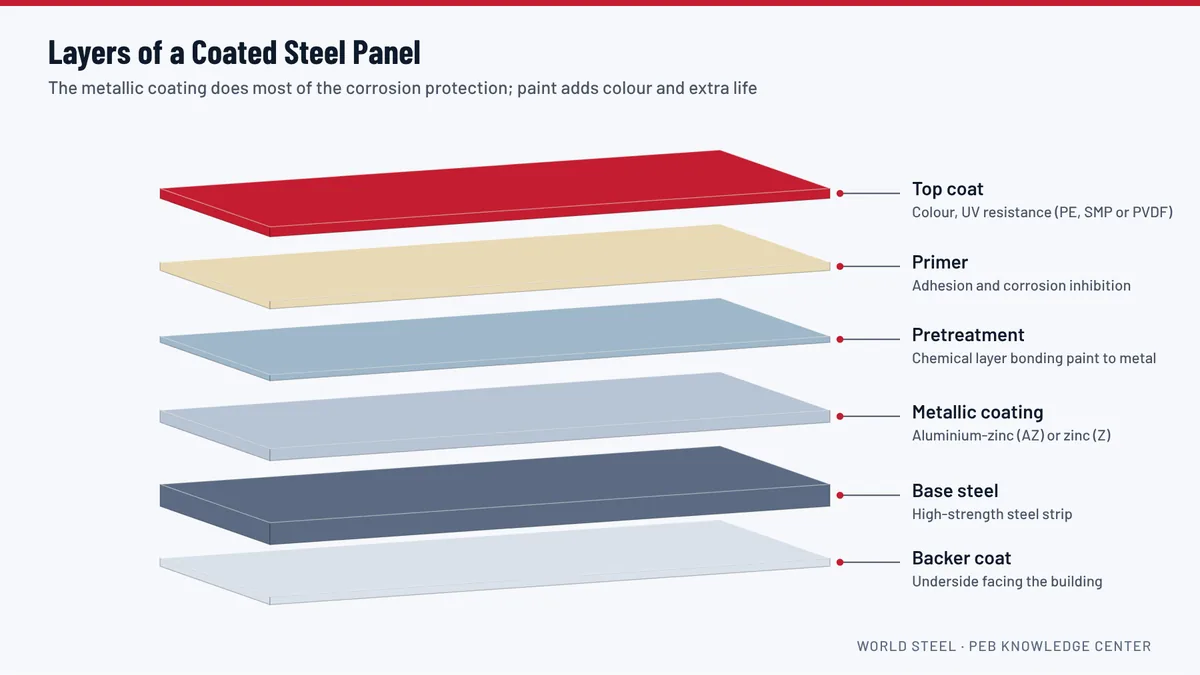
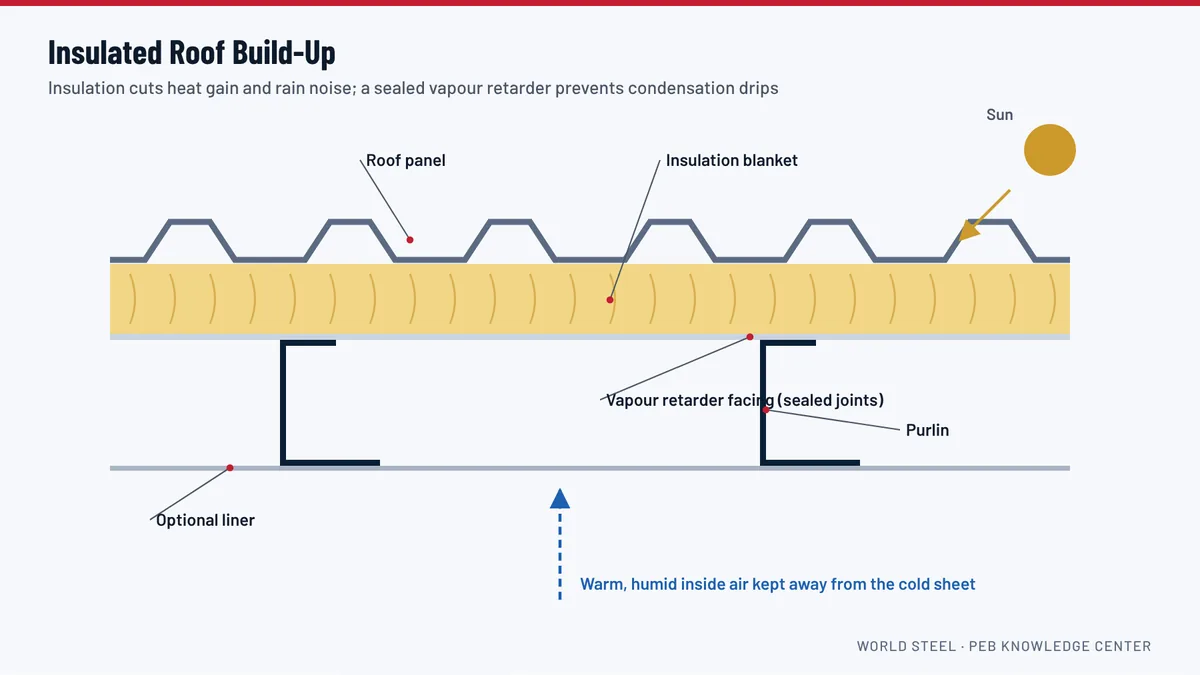
Air holds moisture as vapour. When warm, humid air touches a surface colder than its dew point, the vapour condenses into water. On clear nights, a metal roof radiates heat to the sky and its underside can fall below the dew point of the inside air. Water then forms on the sheet, runs to the purlins and drips. Over time it also attacks the backer coat of the panels and the purlins. Condensation control relies on two things: keeping the warm, moist air away from the cold surface, and keeping that surface warmer.
Insulation blankets
The traditional PEB solution is a roll of glass wool or rock wool insulation with a facing, laid over the purlins before the roof sheets are fixed. The facing, a laminated foil or reinforced vinyl, faces the inside of the building and acts as the vapour retarder. Its joints are overlapped and taped or stapled so the barrier is continuous. The insulation is compressed slightly over the purlins, so longer screws and sometimes thermal spacers are used. Blankets are economical, absorb sound and are easy to ship compactly.
Sandwich panels
Insulated sandwich panels have an insulating core, typically polyisocyanurate (PIR), polyurethane (PUR) or mineral wool, bonded between two steel skins in a factory. They give high insulation in a single layer, a clean internal finish and good airtightness. They are standard for cold rooms, food plants and offices, and increasingly popular for warehouses where internal appearance matters. Mineral wool cores are chosen where fire performance is a priority.
Reflective solutions
Light-coloured roofs and reflective foil layers reduce the radiant heat entering the building. A reflective foil only works if it faces an air space; in direct contact with the roof sheet it acts mainly as a vapour retarder. Reflective coatings and insulation work best together.
Ventilation completes the system
Insulation reduces heat gain; ventilation removes the heat and moisture generated inside. Ridge ventilators, wall louvers and powered fans keep inside air closer to the outside temperature and reduce humidity, which further reduces condensation. See ventilation.
Installation tips
- Keep insulation dry during storage and installation; wet insulation loses performance.
- Seal every joint, penetration and edge of the vapour retarder.
- Support blanket insulation with straps or mesh where spans require it.
- Protect the facing from tears during installation; repair any damage with the specified tape.
For projects in Guyana
In Guyana's hot, humid climate, an uninsulated metal roof will almost always drip on cool nights. For warehouses storing rice, sugar, electronics or packaged goods, and for any building with people working inside, we strongly recommend roof insulation with a sealed vapour retarder, or sandwich panels. See building for Guyana's climate.
Frequently asked questions
Does insulation make a building cooler without air conditioning?
Yes. Roof insulation significantly reduces the heat radiated from the roof into the building. Combined with ventilation, it makes a noticeable difference to comfort.
Which side does the vapour retarder go on?
On the warm, humid side of the insulation, which in an air-conditioned or naturally humid tropical building is usually the inside face. Its joints must be sealed.
Are sandwich panels better than blankets?
They give a cleaner finish and better airtightness. Blankets are more economical and absorb sound well. The choice depends on use and budget.